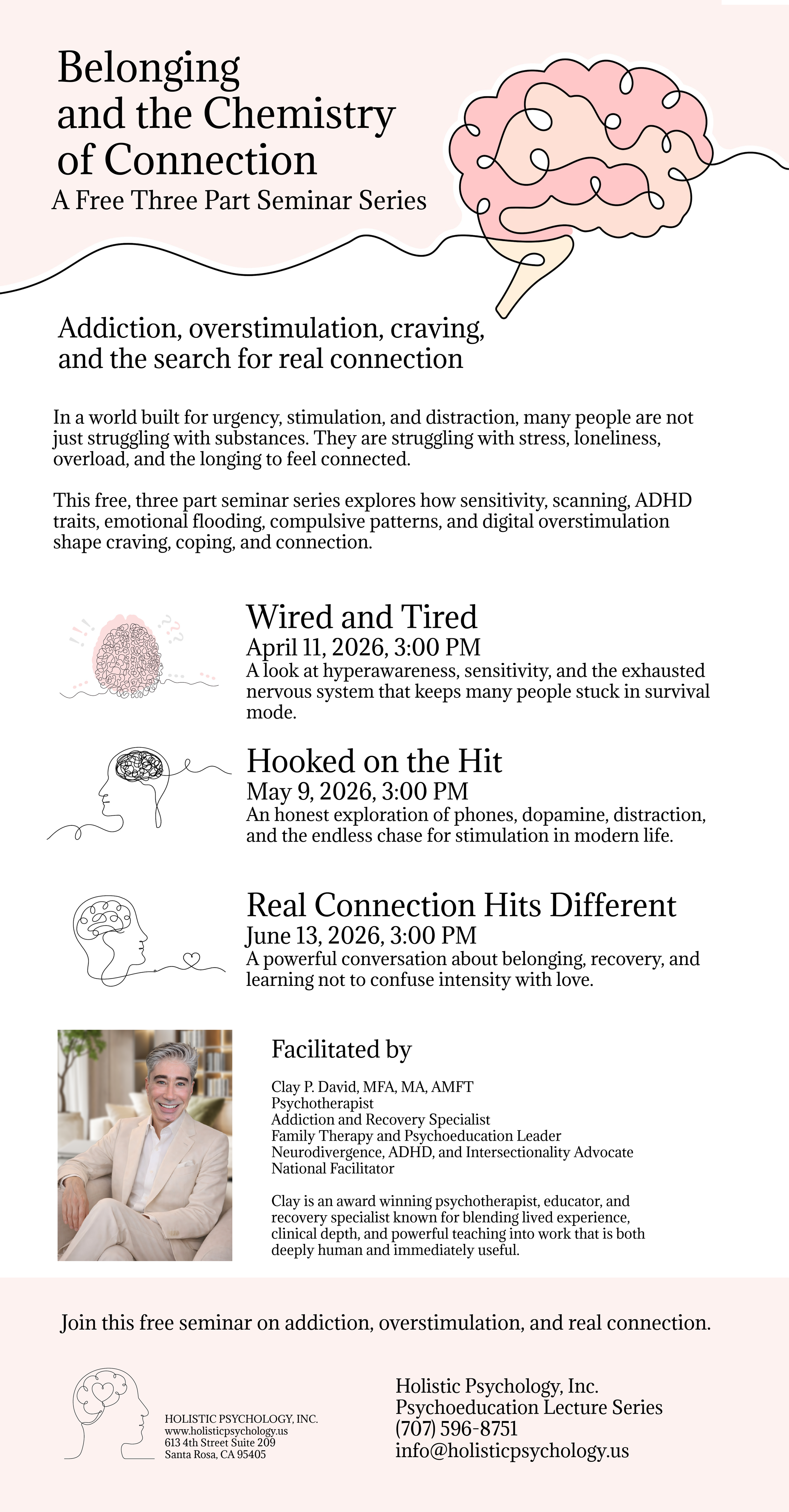
Addiction, Adaptive Awareness, and the Chemistry of Connection
A free three-part seminar series on scanning, sensitivity, stimulation, and connection in modern recovery
Who this series is for? This series is well suited for:
People in addiction recovery
Clinicians and helpers interested in holistic psychology
Highly sensitive and neurodivergent individuals
People navigating ADHD traits and attention fatigue
Participants exploring the impact of phones on regulation and connection
Anyone seeking a deeper understanding of craving, stimulation, and belonging
In this timely and deeply relevant seminar series, Clay P. David, MFA, MA, AMFT explores addiction through the intertwined lenses of holistic psychology, adaptive awareness, neurobiology, and lived recovery insight. This series examines how chronic scanning, hypersensitivity, attention fragmentation, ADHD traits, stimulation seeking, and digital overstimulation can shape the nervous system’s search for relief.
Rather than reducing addiction to willpower or pathology, these seminars invite participants into a more compassionate and clinically nuanced understanding. Many people are not simply struggling with substances or compulsive behaviors. They are struggling with systems that have learned to scan constantly, seek stimulation urgently, and confuse intensity with connection.
Across three one-hour seminars, participants will explore how the addicted nervous system becomes organized around anticipation, urgency, overstimulation, and substitute forms of relief. They will learn how phones, novelty, compulsive patterns, and emotional intensity can mimic connection while deepening isolation. Most importantly, they will begin developing adaptive awareness, the capacity to notice what the system is doing without shame and to choose responses that protect dignity, regulation, and real connection.
This series is designed for those interested in addiction recovery, holistic psychology, neurodivergence, trauma informed care, relational healing, and the impact of modern digital life on attention, regulation, and belonging.
April 11th at 3pm, Seminar One: Adaptive Awareness, Scanning, and the Addicted Nervous System
This opening seminar explores the lived reality of chronic scanning, hypersensitivity, and nervous system overactivation. Many people in recovery are not only managing substance use or compulsive behavior. They are living in bodies and minds that remain on alert, rapidly reading for danger, disconnection, rejection, or stimulation. Some participants may recognize traits associated with ADHD, trauma-based vigilance, emotional flooding, or sensitivity that has long been misunderstood as too much.
This seminar introduces adaptive awareness as a compassionate and practical framework for understanding the difference between sensing and over monitoring, between intuition and alarm, and between real awareness and exhausted vigilance. Participants will explore how the system learns to seek stimulation when rest feels inaccessible and how addiction can emerge as an attempt to regulate intensity, numb overload, or interrupt internal chaos.
Participants will explore:
The meaning of adaptive awareness in recovery
Scanning as survival intelligence
Hypersensitivity and emotional fatigue
ADHD traits, novelty seeking, and restlessness
The difference between stimulation, regulation, and connection
How to begin relating to sensitivity without shame
Participants will leave with:
A deeper understanding of their own scanning patterns
Language for the connection between hyper awareness and addictive coping
A more compassionate view of the nervous system
Practical insight into how recovery begins with awareness that does not punish
May 9th at 3pm, Seminar Two: Dopamine, Stimulation, and the Substitution Loop
This second seminar offers a compelling and accessible exploration of the reward system and the chemistry of craving. Participants will examine why stimulation so often wins over real connection, why cues become powerful before a behavior even begins, and why fast relief can become more compelling than slower forms of healing. The seminar connects dopamine, anticipation, novelty, urgency, and habit formation in a way that is clinically grounded and immediately useful.
Through this lens, addiction is reframed not as a moral failure but as a learned substitution loop. Substances, phones, compulsive sex, chaotic relationships, fantasy, and repetitive rituals can all become ways of altering internal state when the nervous system is under connected, under soothed, or chronically overdriven. Participants will begin tracing how chemistry and emotional need interact, and how the body can become attached not only to a substance or behavior, but to activation itself.
Participants will explore:
How dopamine shapes anticipation and pursuit
Why urgent relief feels so convincing
The relationship between novelty, craving, and compulsion
Why people may become attached to activation and interruption
How substitution patterns form around unmet relational and emotional needs
What it means to interrupt a loop with meaning rather than shame
Participants will leave with:
A clearer understanding of their own craving and stimulation cycles
Insight into the emotional needs beneath repetitive behaviors
A framework for mapping cues, rituals, and rewards
Practical language for replacing self blame with informed awareness
June 13th at 3pm, Seminar Three: Phones, Hyperconnectivity, and the Loss of Real Connection
This final seminar brings the series fully into contemporary life by examining the phone as both a tool and a substitute. Phones offer endless scanning, intermittent reward, pseudo contact, anticipation, and stimulation. For many people, they function as socially acceptable regulation devices that soothe boredom, numb loneliness, heighten vigilance, and intensify compulsive comparison, all while leaving deeper relational needs unmet.
This seminar helps participants understand how digital life can amplify the same nervous system patterns present in addiction. Constant checking, scrolling, waiting for replies, seeking validation, and living in fragmented attention can create a state of hyperconnectivity that paradoxically deepens isolation. Rather than approaching this from a place of moral panic, the seminar invites grounded reflection on how to reclaim attention, restore boundaries, and build forms of connection that nourish rather than drain.
Participants will explore:
Phones as modern stimulation and scanning devices
How digital habits affect sleep, mood, focus, and craving
·The relationship between ADHD traits, attention fragmentation, and constant checking
Why digital contact can mimic connection without creating belonging
How hyperconnectivity can intensify loneliness
What healthy phone boundaries look like in recovery and everyday life
Participants will leave with:
Greater clarity about their own digital coping patterns
A deeper understanding of the emotional and chemical pull of the phone
Practical ideas for reducing overstimulation and reclaiming attention
A more intentional framework for choosing embodied connection over endless contact
About the presenter
Clay P. David, MFA, MA, AMFT
Psychotherapist
Addiction and Recovery Specialist
Family Therapy and Psychoeducation Leader
Neurodivergence and Intersectionality Advocate
National Facilitator
Clay P. David brings together lived recovery experience, holistic psychology, trauma informed insight, and dynamic psychoeducational teaching. His work is known for blending warmth, depth, humor, and clinical sophistication in ways that help participants feel both understood and challenged. With a background in therapy, higher education, expressive communication, and recovery centered facilitation, he offers seminars that are intellectually rich, emotionally resonant, and immediately applicable to real life.
Two-time Golden Apple Professor of the Year and Victor Borge Legacy Award recipient for humor, wit, and grace in communication. Five-time San Francisco Critics Circle award recipient for presentation design excellence, plus the San Francisco TITAN Award for Excellence and the Los Angeles BRAVO Award for Education Excellence.